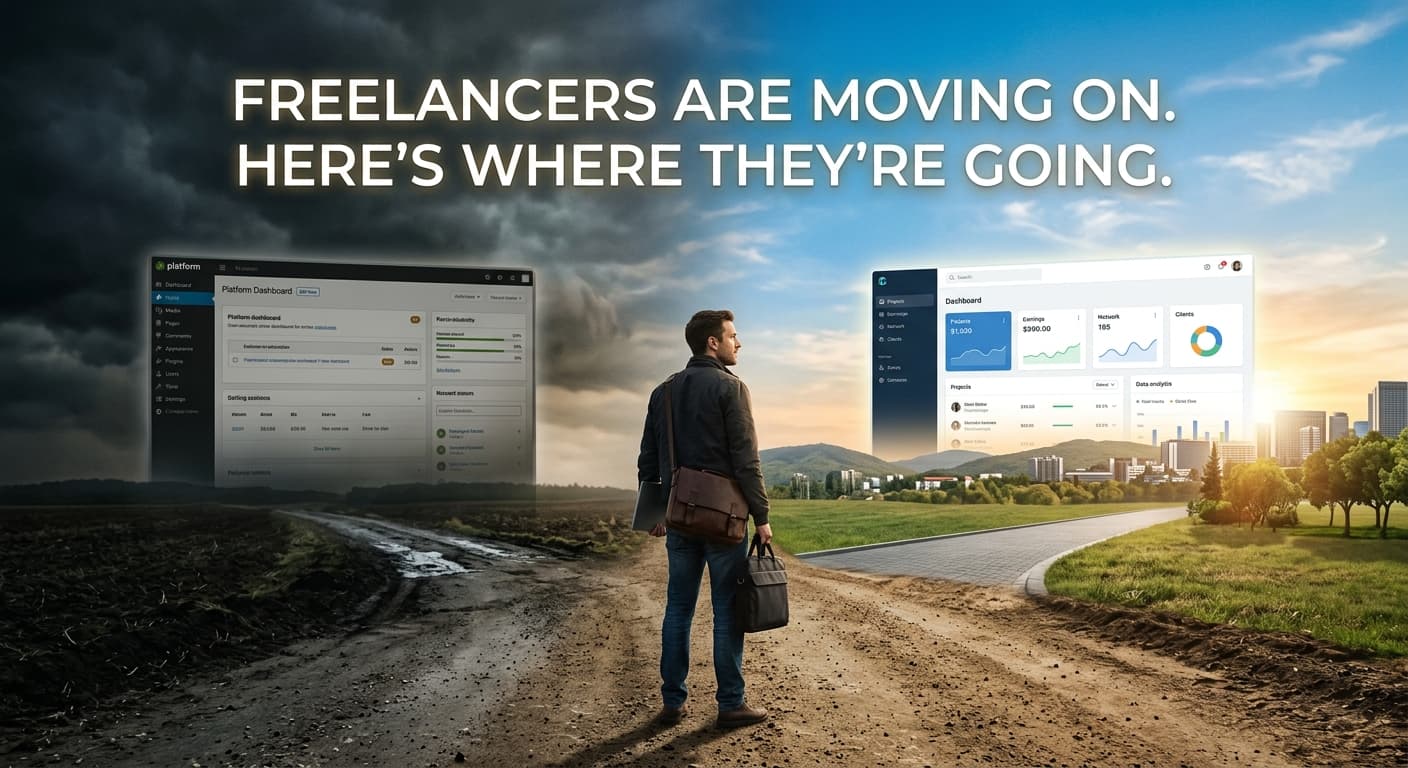
Something Shifted on Upwork — and Freelancers Felt It First
For years, Upwork was the default answer to "how do I find freelance work?" It had the jobs, it had the clients, it had the infrastructure. For all its flaws, it worked — at least well enough that millions of freelancers built their entire income around it.
But somewhere around 2024, something changed. Not one big dramatic moment, but a slow accumulation of decisions that made the platform feel less like a marketplace and more like a toll road. Each change, on its own, felt manageable. Together, they started to feel like the platform was systematically extracting more value from freelancers while delivering less.
The numbers back this up. Upwork's active client base peaked at 832,000 at the end of 2024 and fell to 785,000 by the end of 2025 — a 6% contraction. Q1 2026 added zero net new clients. The buyer pool is shrinking. The competition isn't. And on top of that, the platform just made its most unpopular fee change in years.
Freelancers noticed before the earnings calls did.
This article breaks down exactly why — in real, specific, honest terms — and what the freelancers who are leaving are doing instead.
Reason 1: The New Variable Fee Nobody Asked For
Up until May 1, 2025, Upwork's fee structure was frustrating but at least predictable. You paid 20% on your first $500 with each client, 10% up to $10,000, and 5% on everything above that. It wasn't generous, but you could plan around it.
On May 1, 2025, that changed. Upwork replaced the tiered model with a variable fee ranging from 0% to 15%, determined by an algorithm that considers skill demand, market saturation, and other factors the platform does not fully disclose. You see your fee when you submit a proposal — not before. Once you accept a contract, the rate locks in for its duration. But the next contract? Could be different.
In practice, most freelancers are landing between 10% and 13% on new contracts. Some in oversaturated categories are hitting 15% — a 50% increase from what they were paying before. A small number in high-demand niches may qualify for lower rates. But the majority of the 18 million freelancers on the platform have no way to know which way the algorithm will cut until they're already in the proposal.
When a $500 project now costs you $75 in platform fees instead of a predictable $50, and you couldn't have known that before applying, the trust between the platform and its users quietly breaks.
"You can't just spam 100 proposals a day hoping something sticks. You need to be strategic about which jobs you apply to because every proposal costs you connects, and if you're not getting responses, you're literally burning money." — Freelancer review, 2025
The fee change didn't just cost money. It cost certainty. And certainty, when you're running a freelance business, is worth a lot.
Reason 2: Connects — Paying to Apply for Jobs You Might Not Get
The Connects system has been a source of frustration for years, but it has steadily gotten worse.
Here's how it works: every time you apply for a job on Upwork, you spend Connects. Most job proposals require between 4 and 16 Connects, depending on the job's budget and competition level. Connects cost $0.15 each, available in bundles. New freelancers get 10 free Connects per month and a one-time bonus of 50 when they join. After that, they're buying.
The math adds up fast. If you apply for 40 jobs per month — a reasonable volume for someone actively building their pipeline — at an average of 8 Connects per proposal, you're spending $48 just to apply. And that's before the platform takes its service fee on work you actually win.
But the part that stings the most? Connects are non-refundable if you don't get the job. You can spend $10 in a week applying to five jobs, hear nothing back from any of them, and have nothing to show for it. Upwork refunds Connects only if the job posting is withdrawn — not if you simply didn't win.
Then there's the boost feature. To appear higher in the applicant list for competitive jobs, freelancers can spend additional Connects to boost their proposal's visibility. One experienced freelancer put it plainly: "Upwork's policy of allowing freelancers to pay to boost the visibility of their bids is wrongful. Imagine paying to have your resume viewed over someone else's when applying for jobs."
Active freelancers submitting 15+ proposals per month can spend $200 to $1,100+ annually on Connects alone, before earning a single dollar from a contract.
Reason 3: The Client Pool Is Shrinking — and Getting Harder to Win
Here's a fact Upwork doesn't lead with in its press releases: the active client base on Upwork dropped 6% in 2025, falling from 832,000 to 785,000. Q1 2026 ended at 784,000 — effectively no growth. The buyer pool has been contracting for over a year.
At the same time, the freelancer talent pool hasn't shrunk. There are still 18 million registered freelancers competing for work from a client base that is getting smaller, not larger.
The job market data is equally grim for many categories. In 2025, eleven out of twelve job categories on Upwork saw year-over-year declines in project volume. Overall, the market was down 9%. Writing projects dropped 32%. IT and Networking fell 27%. Web and Mobile Development shrank by 13%. Entry-level projects — critical for new freelancers trying to build their JSS — dropped from 15% of all jobs in 2024 to under 9% in 2025.
More freelancers. Fewer jobs. Higher fees. More expensive applications. The arithmetic is brutal.
Upwork's official framing for the client decline is "low-value, high-volume rationalisation" — deliberately letting low-spend clients churn while focusing on higher-value enterprise accounts. For freelancers doing $500–$2,000 project work, that rationalisation means fewer of their ideal clients are on the platform than a year ago.
Reason 4: The Algorithm That Controls Everything — and Explains Nothing
Upwork's Job Success Score (JSS) is the single most powerful number on your profile. It determines your search visibility, your eligibility for Top Rated status, your ability to get job invites, and ultimately your ability to survive on the platform.
The problem isn't that it exists. It's that it's opaque, fragile, and almost impossible to recover from if it drops.
A JSS of 90% or above is considered excellent. Below 80% and your profile visibility collapses — clients rarely see you in search results, and your proposal win rate plummets. Here's the cruel part: a single negative interaction early in your Upwork career can tank your JSS before you've had a chance to build enough positive reviews to counterbalance it.
The algorithm has also changed in 2025. Upwork now more heavily prioritises freelancers with strong JSS, verified earnings, and consistent platform activity. The algorithmic weighting of new profiles has gotten harder. New freelancers — who are, by definition, unable to demonstrate consistent platform activity — are further disadvantaged at exactly the moment they need the most help.
AI tools introduced as features have added another layer of unpredictability. Uma, Upwork's AI assistant, has been deeply integrated into the job matching and proposal review process. Some freelancers report their proposal visibility changing without clear explanation — one week they're getting responses, the next, nothing changes in their approach but the results do.
Reason 5: Account Suspensions — When Your Income Disappears Overnight
Of all the reasons freelancers are leaving Upwork, this is the one that creates the most visceral fear — and the most justified anger.
Upwork's Trust and Safety enforcement system is no longer primarily human. In 2026, it is a machine-learning infrastructure that correlates browser fingerprints, behavioral biometrics, device signals, and location data, often making enforcement decisions before a human ever reviews the case.
An independent Terms of Service review by ToS Watchdog in January 2026 gave Upwork a fairness score of 42 out of 100 — barely above the industry average of 41. The review noted that Upwork retains broad discretion to suspend or terminate accounts under its ToS, with limited recourse for affected users.
Common triggers for suspension in 2026 include:
Sharing contact details before a contract is in place — even mentioning an email address casually in chat can trigger automated detection
Logging in from a new location — travelling or using a VPN can flag the system
Being associated with a previously banned device or IP address — even if you've never violated any rules yourself
Failing re-identity verification — some longtime freelancers with verified badges are being asked to re-verify, and failing the new system locks their account
Low JSS over time — sustained poor feedback leads to graduated restrictions and eventual suspension
When a suspension happens, the email that arrives is typically vague, citing "irregular activity" without specific detail. Appeals are submitted into a queue. Complex cases can take 3–5 business days. If you were suspended due to bad feedback, you must wait six months before you can even file an appeal.
For a freelancer whose entire income runs through one platform, a sudden suspension isn't an inconvenience. It's a financial emergency.
One writer described the experience: "I woke up one morning to find an email from customer service stating that payment from a client I worked with several weeks earlier never went through. I was done with Upwork." What followed was months of scrambling to rebuild income from scratch.
The risk isn't hypothetical. It's the reason experienced freelancers talk about "Upwork dependency" the way financial advisors talk about putting all your savings into one stock.
Reason 6: The Quality Problem Nobody Talks About
Beyond fees and suspensions, there's a quieter frustration that longtime Upwork freelancers describe: the platform's job quality has gotten worse.
You submit a well-crafted proposal — one you may have spent 30 minutes on — and find yourself competing with 50+ other freelancers. Some of those proposals are AI-generated, generic, and flooding the system. Clients are receiving hundreds of applications for jobs that used to get 20 or 30. The bar for differentiation has never been higher, but the tools to differentiate — a strong proposal, a great profile — have become less decisive as algorithmic ranking and Connects boosting increasingly determine who gets seen.
Meanwhile, the most price-sensitive clients have been driven out of the market (or driven to even cheaper platforms), and the clients that remain on Upwork's general marketplace are often small businesses with tight budgets, unclear briefs, and no experience managing remote freelancers. The premium enterprise clients have been pushed toward Upwork's Business Plus tier, where they're matched with vetted talent — not the general marketplace where most freelancers compete.
The experience of applying for 20 jobs and hearing back from three is not a failure of your proposal writing. It's a systemic feature of a marketplace where the supply/demand ratio has moved decisively against freelancers.
So Where Are They Going?
The good news is that Upwork's problems have created a gap in the market that new platforms are actively trying to fill. Here's where freelancers who are leaving — or diversifying away from — Upwork are moving:
Project Your Vision — Built to Fix What Upwork Broke
Project Your Vision was designed from the ground up to address exactly the problems in this article. No pay-to-apply system. Transparent, predictable fees with no algorithmic surprises. Fast payment release. Fair profile visibility that doesn't bury new freelancers under years of accumulated reviews from established profiles.
It's the platform for freelancers who are serious about building a sustainable business — not just surviving on one that increasingly works against them.
[Create Your Free Profile on Project Your Vision →]
Contra — Zero Commission
Contra charges freelancers absolutely zero commission on earnings. It now hosts over 1 million freelancers and thousands of companies including Amazon and Google clients. The portfolio-forward profile system and growing tech/startup client base make it a strong option for designers, developers, and marketers. Best access to jobs requires a Pro subscription, but the zero-take-rate model makes it worth exploring.
Toptal — For Senior Talent
Toptal accepts only the top 3% of applicants through a rigorous vetting process — but if you pass, you access premium enterprise clients with zero freelancer commission. Fees are absorbed on the client side. Weekly payments. No bidding wars. For experienced senior developers, designers, and finance professionals, it remains the most financially rewarding option if you can clear the bar.
Guru — Lower Fees, Smarter Structure
Guru's commission ranges from 5–9% depending on membership tier — significantly below Upwork's average effective rate. The SafePay escrow system protects payments, and the WorkRoom feature gives freelancers and clients a shared collaborative space. Strong for repeat work and long-term client relationships.
Direct Client Work via LinkedIn and Cold Outreach
The freelancers doing the best in 2026 are the ones who stopped relying on any single platform. LinkedIn ProFinder, targeted cold email campaigns, and referral-based networks are driving consistent work for freelancers across every category — with zero platform fees and full ownership of client relationships.
The most important lesson from the Upwork experience: build your client base on channels you control, and use platforms to supplement — not replace — that foundation.
The Real Lesson: Never Build Your Business on Land You Don't Own
There's a principle in digital business called "building on rented land" — the risk that comes from building your entire income on a platform controlled by someone else. Upwork can change its fees. It can change its algorithm. It can suspend your account. It can shrink its client base. And there's nothing you can do about any of it.
The freelancers who are leaving aren't necessarily quitting Upwork entirely — many of them are diversifying. They're building direct client relationships, setting up profiles on lower-fee platforms, and treating Upwork as one channel among several rather than the foundation everything else rests on.
That's the right move — and it's available to you regardless of whether you've been on Upwork for a week or five years.
Frequently Asked Questions
Why are freelancers leaving Upwork in 2026?
The main drivers are the new variable fee structure (0–15%, averaging 10–13% for most freelancers, introduced May 2025), rising Connects costs that charge freelancers to apply for jobs with no guarantee of winning them, a shrinking client pool (down 6% in 2025 to 785,000 active clients), declining job volumes across most categories, opaque account suspension risks, and an algorithm-driven JSS system that is increasingly difficult for new and mid-level freelancers to navigate.
How much do Upwork Connects actually cost per year?
Active freelancers submitting 15 or more proposals per month can spend between $200 and $1,100+ annually on Connects alone, according to fee analysis data. This is before any service fee on won contracts. Freelancers who submit 40+ proposals per month to maintain a healthy pipeline are spending $40–$80/month just on application costs.
Can Upwork suspend your account without warning?
Yes. Upwork's Trust and Safety system now uses machine-learning infrastructure that can flag and restrict accounts based on behavioral signals before a human reviewer is involved. Common triggers include sharing contact details before a contract is in place, logging in from a new location, being associated with a previously flagged device or IP, and failing re-identity verification. Suspension notices are often vague, and appeals can take 3–5 business days or longer.
Is Upwork worth it for new freelancers in 2026?
The honest answer is: it's harder than it used to be. Entry-level jobs represent under 9% of all Upwork listings in 2025, down from 15% in 2024. New profiles are at an algorithmic disadvantage, Connects cost money before you earn anything, and the job market across most categories is down 9% year over year. Most career advisors now recommend using Upwork as one of several platforms — not the only one — and building direct client relationships alongside it.
What is the best alternative to Upwork in 2026?
There's no single answer — the best alternative depends on your skill set, experience level, and priorities. Project Your Vision offers the fairest overall structure for all freelancers. Contra is the strongest zero-commission option. Toptal is unmatched for senior technical professionals. Guru provides the best fee structure for long-term client relationships. Many successful freelancers use a combination: one platform for inbound discovery, direct outreach for relationship-driven work, and LinkedIn for professional credibility.
Does Upwork's new fee affect existing contracts?
No. Contracts started before May 1, 2025 retain their original fee structure until completion. Only new contracts started after that date are subject to the variable 0–15% model.
External Resources
Upwork's Official Fee Documentation — Check your current contract fee before accepting work
GigRadar Upwork Market Report 2026 — Data-backed analysis of Upwork's shrinking client base and proposal trends
Vollna 2025 Upwork Projects Report — Category-by-category breakdown of job volume changes
GoLance — Upwork Account Suspension Guide — What to do if your account gets suspended
Contra — Zero-commission freelance platform
Guru — Low-fee freelance marketplace with SafePay escrow
Toptal — Premium freelance network for senior professionals