Why Small Businesses Are Turning to Freelancers in 2026
The traditional 9-to-5 hiring model was built for a different era. Long-term commitments, substantial overhead, a three-month recruitment cycle, benefits, equipment, desk space — hiring a full-time employee is a significant undertaking even in the best of times.
Freelancers offer something fundamentally different: you access exactly the expertise you need, exactly when you need it, and you pay only for productive hours or specific deliverables.
The numbers tell the story. The freelance workforce has expanded rapidly — an estimated 80 million Americans are now freelancing, and that number is projected to top 90 million by 2028. The U.S. freelance platforms market alone is projected to grow from $1.17 billion in 2023 to nearly $2.8 billion by 2030.
The MetLife and U.S. Chamber of Commerce Small Business Index shows that roughly one in four small business owners now lists "talent" — either recruiting or retaining it — as their top concern. Freelancers directly address that concern. They bridge the gap between "we need this done now" and "we can't hire a full-time person yet."
But hiring a freelancer isn't the same as hiring an employee. The process is different, the pitfalls are different, and the mistakes are expensive. This guide walks you through every step.
Step 1: Get Crystal Clear on What You Actually Need
The most expensive mistake small business owners make when hiring a freelancer is skipping this step.
Before you write a single word of a job post, you need to be able to answer three questions precisely:
1. What is the specific deliverable?
Not "help with marketing" — that's a department, not a project. Specific deliverables sound like:
"A 5-page website built in Squarespace with contact form and blog"
"12 SEO-optimized blog posts, 1,200–1,500 words each, on [topic]"
"A complete brand identity: logo, color palette, typography guide, and business card design"
"A Facebook and Instagram ad campaign, 3 ad variants, targeting setup, and 30-day performance report"
The more specific you are, the more accurate the proposals you'll receive — and the less time you'll waste.
2. What does success look like?
How will you know when the project is complete and done well? Define measurable success criteria. "The website should load in under 2 seconds" is measurable. "The website should look good" is not.
3. What's the timeline?
Be realistic. Freelancers are managing multiple clients. "ASAP" is not a timeline — "live by June 30" is. If you have a hard deadline, name it upfront.
Once you've answered all three, you're ready to write a job post.
Step 2: Set a Realistic Budget — Before You Post Anything
Budget is the step most small business owners rush or skip. Then they're surprised when proposals come in 3x over what they expected, or they attract the wrong caliber of talent by posting with no budget at all.
Here are realistic 2026 freelance rate benchmarks to anchor your expectations:
Hourly Rate Benchmarks (US-based, mid-level freelancers):
Role                          Typical Hourly Rate (Mid-Level, US)
-------------------------------------------------------------------
Web Developer (Full-Stack)    $50–$90/hr
Web Designer                  $40–$75/hr
Graphic Designer              $30–$60/hr
UX/UI Designer                $60–$120/hr
Copywriter / Content Writer   $35–$75/hr
SEO Specialist                $50–$100/hr
Social Media Manager          $30–$65/hr
Digital Marketing Strategist  $60–$120/hr
Video Editor                  $40–$80/hr
Virtual Assistant             $20–$45/hr
Bookkeeper / Accountant       $30–$60/hr
Software Developer            $65–$120/hr
AI/ML Specialist              $100–$200/hr
The US average freelance hourly rate across all categories is $47.71 in 2026, according to ZipRecruiter data. Specialists command significantly more.
A few important budget realities:
Platform rates run 20–40% lower than direct-hire rates. A $50/hour developer on a freelance platform might charge $75–$90/hour if you hired them directly. Both can represent similar talent.
Offshore rates are significantly lower. A mid-level web developer in Eastern Europe or South Asia may charge $20–$40/hour for equivalent quality to a US-based developer at $70–$90/hour. This is legitimate — but be prepared to manage time zone differences.
Don't anchor to the cheapest bid. The cheapest option isn't always the worst — but the most expensive isn't always the best. Focus on fit, clarity, and reliability. In freelancing, the lowest-priced proposal often reflects either inexperience or a freelancer who will make up the margin through scope expansion.
If you're working with a tight startup budget, be honest about it in your posting. Good freelancers would rather know upfront than waste both your time with a proposal that doesn't fit.
Step 3: Write a Job Post That Attracts the Right People
Your job post is your first impression. A vague, poorly written post attracts vague, poorly calibrated proposals. A clear, detailed post attracts professionals who can accurately assess whether they're the right fit.
What your job post must include:
Project overview (2–3 sentences) What is your business? What problem are you trying to solve? Give just enough context for a skilled freelancer to understand your world.
Example: "We're a 3-person e-commerce brand selling sustainable home goods. We currently have no consistent content strategy and want to build one from scratch, starting with SEO-optimized blog content."
Specific deliverables List what you need. Use bullet points. Be as specific as Step 1 taught you to be.
Timeline Start date and hard deadline (if any). Estimate the total hours if it's an hourly project.
Budget range Include it. Freelancers filter jobs by budget. If you don't include a range, you signal either that you haven't thought about it or that you're trying to hide it — neither creates a good first impression.
Skills required List specific tools or experience. "WordPress, Elementor, WooCommerce" beats "web skills."
What a great proposal looks like Tell them what you want to see. "Please include a link to your portfolio and briefly explain how you've handled a similar project" will filter out lazy mass-applicants.
One thing to avoid: posting a vague brief and saying "looking for the best price." This attracts a race to the bottom that wastes your time and leads to hiring the wrong person.
Step 4: Where to Post Your Job
You have more options than Upwork and Fiverr. Here's a realistic breakdown for small businesses in 2026:
Project Your Vision — Best Overall for Small Businesses
Project Your Vision is designed with both sides of the marketplace in mind — clients get access to serious, professional freelancers without the inflated buyer-side fees that platforms like Upwork charge on top of the freelancer's rate. Transparent fee structure, quality profiles, and a growing talent base across every major category.
Upwork — Largest Talent Pool
Upwork has over 18 million freelancers and 780,000+ active clients, making it the largest freelance marketplace by volume. Note that Upwork charges clients a service fee on top of freelancer rates (up to 10%), and the May 2025 fee restructure has caused some friction with top-tier talent. Still a strong option for finding vetted talent, especially if you use the Business Plus tier for AI-powered matching.
Toptal — Best for Senior Technical Talent
Toptal accepts only the top 3% of applicants through rigorous vetting. If you need a senior developer, finance expert, or specialized designer, Toptal's screening process does a lot of the work for you. Higher rates, but lower risk of getting burned by inexperience.
Contra — Best for Startup Budgets
Zero commission platform now hosting over 1 million freelancers including clients from Amazon and Google. Strong for design, development, and marketing talent. The zero-fee model keeps costs lower on both sides.
LinkedIn ProFinder — Best for Professional Services
Ideal for hiring consultants, coaches, financial advisors, and professional services providers. You can see their full professional history and endorsements before reaching out. Strong for B2B service roles.
Guru — Best for Long-Term Engagements
Lower fees than Upwork (5–9%), strong escrow protection, and a good environment for ongoing retainer work. Solid for design, writing, development, and administrative roles.
Pro tip: Post on 2 platforms simultaneously for your first hire. The difference in proposals received gives you a much better sense of market rate and available talent than relying on one source.
Step 5: Evaluate Portfolios Like a Professional
A portfolio is not a list of past clients. It's evidence of skill, process, and results. Here's how to evaluate one properly:
Look for Relevance Over Volume
You don't want to see 50 projects spanning 12 industries. You want to see 3–5 projects that are similar to yours — same industry, same type of work, similar scope. A freelancer who shows you a project nearly identical to what you're hiring for is worth far more than someone with a massive generic portfolio.
As one expert advises: show clients the 2–3 projects most similar to their project, not your entire body of work.
Look for Case Studies, Not Just Samples
The best portfolios show the problem, the process, and the result — not just the final output. A designer who shows you a logo is showing you an image. A designer who shows you "the brief was X, we went through three concepts, here's why we chose direction 2, and here's the client's brand results six months later" is showing you how they think.
Look for portfolios that include:
The original problem or brief
The approach taken
The outcome, ideally with measurable results
Check Platform Metrics (If Applicable)
On platforms that show it, benchmark these numbers:
Completion rate: 90%+ is a strong signal
Client satisfaction score: 4.5/5 or higher
Response time: Within 24 hours for initial messages
Repeat hire rate: Clients hiring the same freelancer again is a strong trust signal — research shows repeat hiring correlates with 3.2x higher project satisfaction
Ask for References or Referrals
For projects over $1,000, it's completely reasonable to ask for one past client reference you can contact. A confident, legitimate freelancer will have no problem providing one.
Step 6: Conduct a Discovery Call — Don't Skip This
Proposals tell you what a freelancer thinks you want to hear. A 30-minute video call tells you whether they actually understand your problem.
What to assess on the call:
Do they ask good questions? A skilled freelancer asks about your goals, your constraints, your timeline, and what success looks like before they talk about themselves. If a freelancer spends the whole call pitching, that's telling.
Do they push back where appropriate? The best freelancers will respectfully flag concerns — a timeline that seems unrealistic, a budget that may not cover the scope, a technical approach that won't achieve what you think it will. Someone who agrees with everything you say is either inexperienced or telling you what you want to hear.
Can they explain their process clearly? Ask: "Walk me through how you'd approach this project." A clear, step-by-step answer shows experience. Vagueness shows the opposite.
Do they communicate in a way that works for you? Think about time zones, communication style, and responsiveness. A mismatch here will create friction throughout the project.
Step 7: Set the Budget and Structure the Contract
Hourly vs. Fixed Price
Fixed price works best for projects with clearly defined deliverables and scope. You agree on an outcome and a price. The risk shifts to the freelancer to deliver within that budget.
Hourly works best for projects where the scope may evolve, or when you're hiring for ongoing work. The risk shifts back to you — if the project takes longer than estimated, you pay more. Always require a weekly hours cap with hourly contracts.
What Your Freelance Contract Must Cover
Even for small projects, a written agreement protects both sides. Every freelance contract for a small business should include:
1. Scope of work What is and isn't included. This is your primary defense against scope creep.
2. Deliverables and milestones Specific outcomes tied to payment milestones. "Payment of $500 upon delivery of approved wireframes" beats "payment upon completion."
3. Timeline Start date, milestone dates, and final delivery date.
4. Payment terms Amount, method, and due dates. For projects over $500, always use a milestone structure — never pay 100% upfront.
5. Revision policy How many rounds of revisions are included? What happens if you need more? Define this before the project starts.
6. Intellectual property and ownership Who owns the work once it's delivered and paid for? For most creative work, the client should receive full ownership upon final payment. Make sure this is explicitly stated — without clear assignment language, disputes are almost inevitable.
7. Confidentiality If the freelancer will access sensitive business information, an NDA clause protects you.
8. Termination terms What happens if either party wants to exit? How much notice is required? What payment is owed for work completed?
Use Platform Escrow When You Can
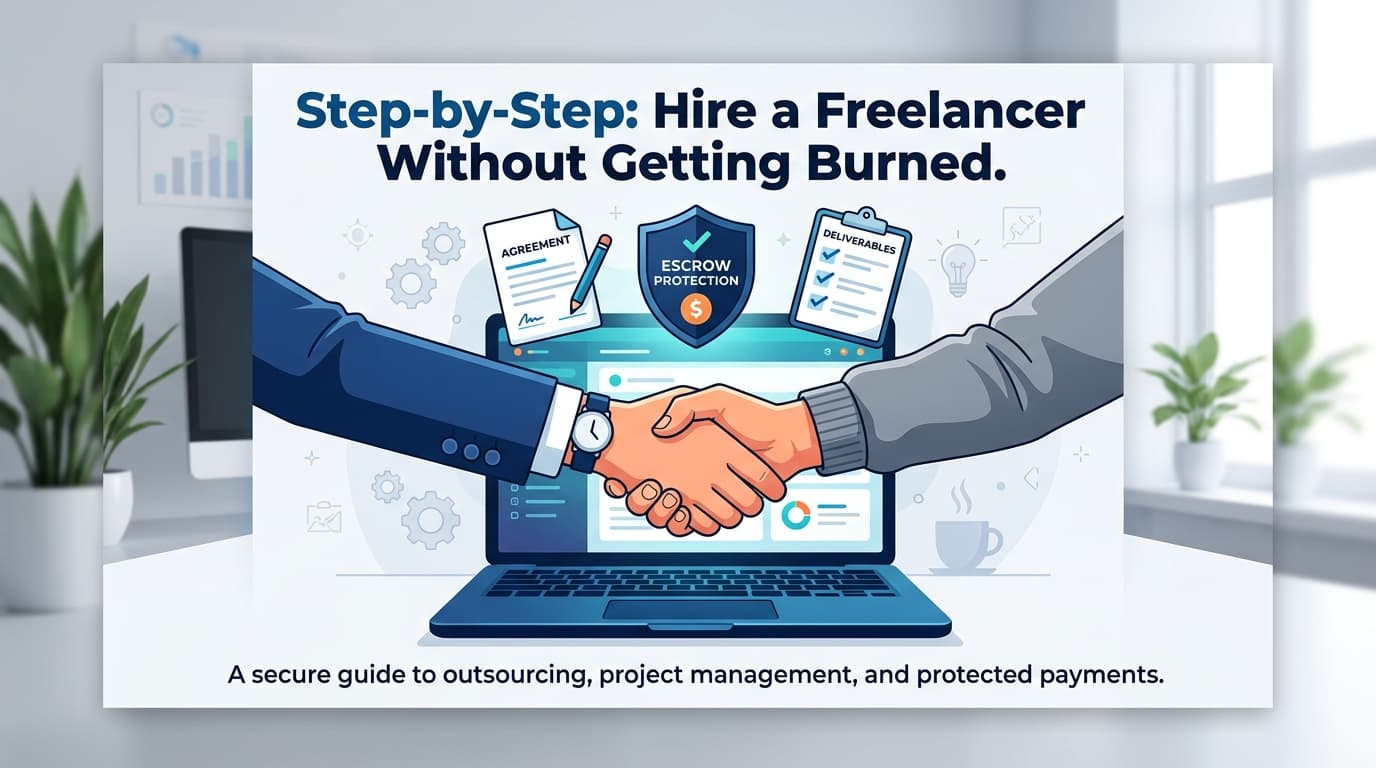
Platforms like Project Your Vision, Upwork, and Guru hold client funds in escrow and release them to the freelancer upon milestone approval. This protects both sides — the freelancer knows the money exists before starting work, and you know the work must be delivered before funds release. For your first hire especially, using an escrow-enabled platform removes a significant layer of financial risk.
Step 8: Spot These Red Flags Before You Hire
The worst freelance experiences are almost always avoidable. Here are the warning signs experienced business owners have learned to watch for:
🚩 They avoid a written contract or scope discussion Any legitimate freelancer expects a contract. Someone who resists it or says "we can sort it out as we go" is either inexperienced or planning to be flexible with your expectations in ways that benefit them.
🚩 The bid is dramatically lower than everyone else If 10 proposals come in at $800–$1,200 and one comes in at $150, the outlier is either inexperienced, planning to upsell you aggressively, or has misunderstood the scope. Clarify before assuming it's a deal.
🚩 No verifiable past work A portfolio with no client names, no context, and no results is easy to fabricate. Ask for references or live examples you can visit/verify.
🚩 They tell you how long the project will take before understanding your requirements If a developer says "that'll take about two days" before you've finished explaining the project, they're either guessing or lowballing to win the work.
🚩 They request payment entirely upfront A small deposit (25–30%) to start a project is standard. 100% payment before any work begins is a red flag — especially from a freelancer you haven't worked with before.
🚩 Vague communication in proposals A proposal that could have been written for any client — no specific references to your project, no demonstration of understanding your industry — signals someone who's mass-applying without reading your brief.
🚩 They push to communicate and pay outside the platform before a contract is signed Legitimate freelancers understand platform rules. Someone aggressively trying to move off-platform before work begins is trying to avoid the protection and accountability that escrow provides.
Step 9: Onboard Them Properly — This Step Is Underrated
Hiring is only half the job. How you onboard a freelancer determines the quality of what you receive.
Even though freelancers are independent professionals, a good onboarding sets them up to succeed — which means you succeed.
Send a project brief document Even if you discussed everything on a call, put it in writing. Include background on your business, your target audience, your brand guidelines (if you have them), examples of work you like (and don't like), and the success criteria you defined in Step 1.
Introduce them to your tools If they'll need access to your website, social accounts, project management tools, or documents, set up appropriate permissions before day one.
Define the communication cadence How often will you check in? Via what channel? What's the expected response time for messages? This prevents the frustration of "I emailed three days ago and heard nothing" or "they message me at 11pm."
Share feedback preferences Tell them how you like to give feedback. Some clients prefer consolidated notes in a document. Others prefer a short call. The clearer you are about this upfront, the smoother revision cycles will be.
Step 10: Manage the Project and Protect the Relationship
Once work begins, your job is to be a good client. This matters more than most business owners realize — top freelancers choose their clients, and the ones who treat collaborators with respect and clarity get better work, faster.
Give feedback that's specific and actionable "I don't love this" is not feedback. "The headline feels too casual for our enterprise audience — can you try something that leads with the business outcome rather than the feature?" is feedback.
Respect the agreed scope Scope creep — adding requests incrementally after the contract is signed — is the most common source of friction between clients and freelancers. Small additions feel harmless one at a time, but they compound. If you want to expand the scope, acknowledge it explicitly and discuss whether the budget and timeline need to adjust.
Pay on time This is non-negotiable. Freelancers are small businesses too. A freelancer who gets paid on time, every time, becomes a long-term resource you can call on whenever you need them.
Give a review after the project On any platform that supports it, leave a detailed review. Good freelancers rely on reviews the way employees rely on references. A thoughtful, honest review takes five minutes and makes a real difference to their career.
The 10-Point Checklist: Hiring a Freelancer in 2026
Before you post your job, run through this checklist:
✅ Defined specific deliverables (not vague goals)
✅ Set measurable success criteria
✅ Established a clear timeline with a hard deadline
✅ Researched market rates for your project type
✅ Set a realistic budget range
✅ Written a detailed job post with skills required
✅ Posted on at least one quality platform
✅ Reviewed portfolios for relevance + process + results
✅ Conducted a discovery call with your shortlist
✅ Contract covers: scope, deliverables, IP, payment, revisions, termination
Frequently Asked Questions
How much should I budget to hire a freelancer for my small business?
It depends on the skill and the scope. The US average freelance hourly rate is $47.71 in 2026 across all categories. Web developers range from $50–$90/hour for mid-level talent. Copywriters range from $35–$75/hour. Virtual assistants run $20–$45/hour. For a one-page website redesign, budget $500–$2,000. For a complete brand identity, budget $800–$3,000. For ongoing monthly content, budget $500–$1,500/month. Always budget 10–15% above your initial estimate for revisions and scope adjustments.
What is the best platform to hire a freelancer for a small business in 2026?
Project Your Vision offers the best overall structure for small business owners — quality talent, transparent fees, and no surprise buyer-side surcharges. Upwork has the largest volume but charges clients additional fees on top of freelancer rates. Toptal is best for senior technical or finance roles. Contra is strong for budget-conscious startups. The right choice depends on your budget, skill need, and how hands-on you want the hiring process to be.
Should I use hourly or fixed-price contracts?
Fixed price is almost always better for small businesses with defined, one-time projects. It gives you cost certainty and aligns the freelancer's incentive with delivering the outcome, not logging hours. Use hourly contracts only for ongoing work where the scope isn't fully defined, or when you need a freelancer to be responsive to evolving needs.
How do I protect myself from getting scammed?
Use a platform with escrow payment protection for your first hire. Never pay 100% upfront. Always get a written contract before work begins. Verify past work with live links or references. If something feels too good to be true — unusually low price, unusually urgent timeline, someone pushing to go off-platform immediately — trust that instinct.
Can I hire a freelancer on a very small budget?
Yes, but be realistic about what that budget covers. A $200 budget for a website redesign will get you a very limited scope, or talent from markets with significantly lower rates. Be specific about scope — a $200 budget for "update 3 product pages using my existing template" is very different from "$200 for a complete website." The more specific your scope, the better calibrated the proposals you receive.
What should a freelance contract include?
At minimum: scope of work, deliverables and milestones, timeline, payment terms, revision policy, IP ownership, confidentiality, and termination terms. For projects over $500, consider having a simple contract template reviewed by a business attorney once — then reuse it with minor modifications for future hires.
Ready to Post Your First Job?
Hiring a freelancer is one of the highest-leverage moves a small business can make. Done right, you get access to specialized expertise you couldn't afford to hire full-time, on exactly the timeline you need it, without the overhead of employment.
Done wrong, it costs you time, money, and confidence.
The steps in this guide aren't complicated — but skipping them is what leads to those "nightmare freelancer" stories. Follow the process, be a clear communicator, pay fairly, and treat the relationship with professional respect. That's the formula that turns a one-time hire into a long-term business asset.
Project Your Vision makes it easy to post a job, receive proposals from serious professionals, and manage the entire process with escrow payment protection and transparent fees — all in one place.
Post Your First Job on Project Your Vision
Useful External Resources
US Chamber of Commerce — How to Hire a Freelancer — Official guidance for small business owners
Business.com — What to Look for When Hiring Freelancers — Expert tips on vetting talent
Toptal — For senior developers, designers, and finance experts
Contra — Zero-commission platform for budget-conscious hires
Guru — Strong escrow and SafePay for project protection
Clockify — Freelancer Rate Benchmarks 2026 — Updated hourly rate data by category
LinkedIn ProFinder — Professional services and consulting