The Lie Nobody Tells You When You Start Freelancing
You spend three hours setting up your Upwork profile. You optimize your headline, write a thoughtful bio, choose your skills carefully. You hit publish.
Then you wait.
And wait.
Day two, you spend $5 buying Connects to apply for three jobs. You write personalized proposals for each one. You hear nothing back. You apply for five more. Still nothing.
Two weeks later, you're starting to wonder if freelancing is even real.
Here's what nobody told you: Upwork and Fiverr are not where you find your first client. They're where you find your fifth. Maybe your tenth. The first one comes from somewhere much closer to home — and it's available to you right now, today, before you've built a portfolio or collected a single review.
Your first freelance client comes from your network, not Upwork. The path is simpler than most beginners think: reach out to people who already know you, deliver one project on time, and collect a testimonial.
Everything else — the portfolio, the platform profile, the cold email campaigns — builds on top of that first win. But you have to get the first win first.
This guide shows you exactly how to do that. Step by step, in the right order, with zero assumptions about how much experience you already have.
Why Upwork and Fiverr Are the Wrong Starting Point
Before we get into what to do, it's worth understanding why the platforms fail beginners so consistently — because it's not just bad luck.
On Upwork, you're a new profile with zero reviews competing against thousands of established freelancers for the same jobs. Clients can see how many proposals a job has received. When they see 47 proposals and yours has no feedback, no history, and no social proof, they move on. The platform's algorithm also weights Job Success Score and profile completion heavily in search rankings — metrics that take months to build. Getting those first reviews is a classic chicken-and-egg problem, and spending money on Connects to apply for jobs you're unlikely to win is demoralizing before you've earned a single dollar.
On Fiverr, the gig discovery model means buyers browse thousands of listings and buy from sellers with the most reviews and the most attractive gig images. A new seller with zero reviews and no order history is invisible in Fiverr's search. You can sit with a perfectly written gig for weeks and get nothing — not because your service is bad, but because Fiverr's algorithm hasn't given you any visibility yet.
Neither platform is designed to help beginners. They're designed to reward people who are already succeeding on them.
So stop starting there. Here's where to start instead.
Step 1: Get Clear on What You're Selling (Before You Talk to Anyone)
The most common reason beginners fail to land clients isn't lack of contacts or experience. It's that they can't clearly explain what they do and who it's for.
"I do graphic design" is not a service. "I create social media graphics for e-commerce brands" is a service.
"I write content" tells a potential client nothing. "I write SEO blog posts for SaaS companies" tells them exactly what you offer.
Before you reach out to a single person, answer these three questions:
1. What specific service do you provide? Be as specific as possible. Logo design, not "design." Email copywriting, not "writing." WordPress website builds, not "web development."
2. Who do you provide it for? Think in terms of industries or business types: real estate agents, online coaches, local restaurants, e-commerce stores, law firms, SaaS startups.
3. What result does your work create? Clients don't buy services — they buy outcomes. More customers, more revenue, less time wasted, better-looking brand. Connect your service to a real business result.
Once you can answer all three in one sentence — "I help [who] achieve [result] through [service]" — you're ready to talk to people.
Step 2: Mine Your Existing Network (This Is Where Your First Client Is Hiding)
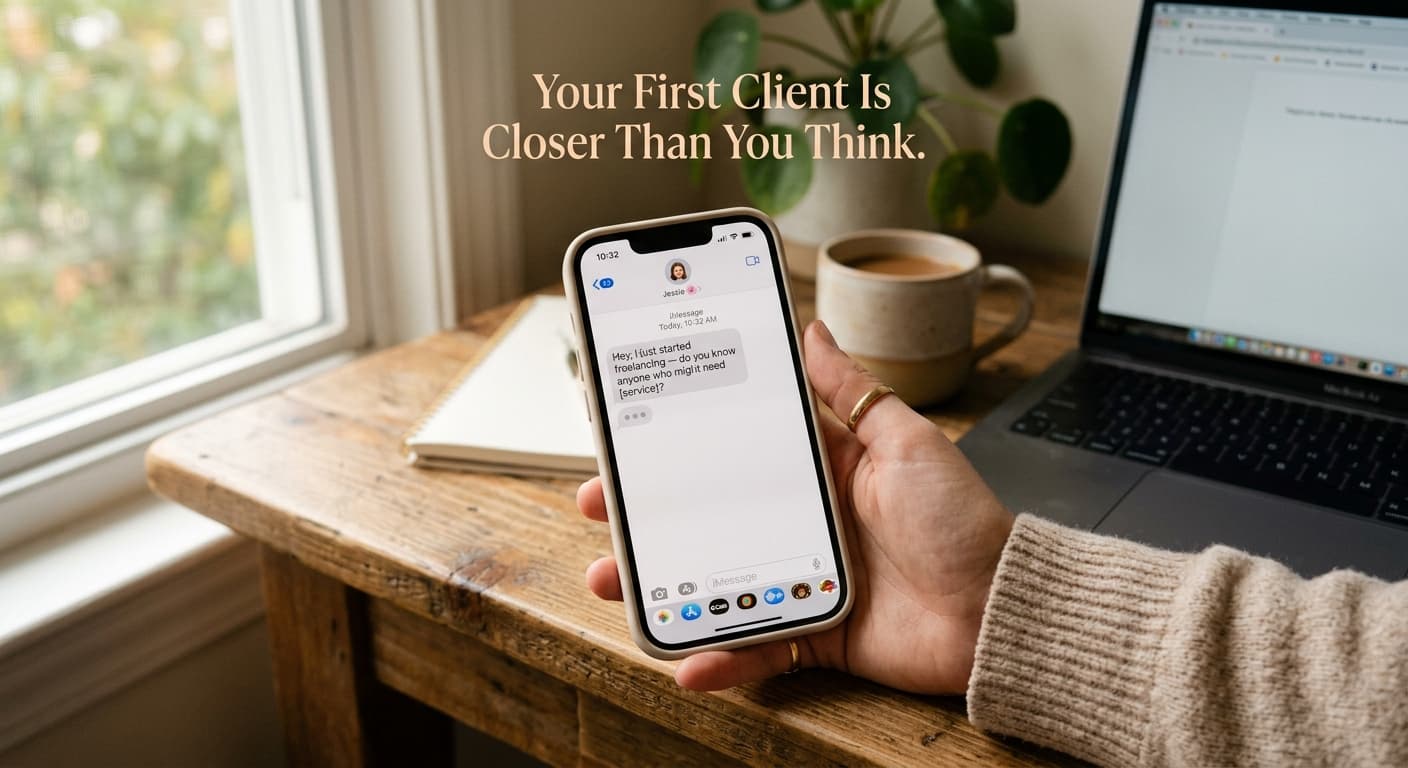
Nobody's first freelance client comes from a cold pitch on Upwork. That's the second client, maybe the third. The first one comes from a text message — a former coworker who needs a website but can't afford an agency, a cousin's small business that needs someone to fix their email marketing, a friend of a friend who heard you're good with design and has a $300 logo job.
Open your phone contacts right now. Open LinkedIn. Think about:
Former colleagues and classmates
Friends who run small businesses or side projects
Family members in business or with professional networks
People you've worked with in any context — part-time jobs, internships, volunteering
Acquaintances active on social media who own businesses
You're not looking for people who need your exact service. You're looking for people who might know someone who does.
The message to send:
Keep it short. Keep it human. Don't pitch — announce.
"Hey [Name], hope you're doing well. I've recently started offering [specific service] to small businesses and startups. If you ever come across anyone who might need help with [specific result], I'd love a referral. Happy to return the favour any time."
That's it. No long pitch. No formal proposal. Just a simple, direct message to someone who already has a reason to want to help you.
Send this to 20–30 people over the next week. Some will know someone. That someone becomes your first client.
Why this works: People buy from people they trust. Referrals come pre-loaded with trust. A referred client doesn't need to be convinced you're legitimate — someone they already trust vouched for you. That's worth more than any portfolio.
Step 3: Build a Simple Portfolio — Even If You Have No Clients Yet
Here's the paradox every beginner faces: you need a portfolio to get clients, but you need clients to build a portfolio. The no-experience paradox stops talented people before they even start — but the premise is wrong. You don't need client experience to build a compelling freelance portfolio. You need real work. And you have more real work available to you than you realize.
Here's how to create legitimate portfolio pieces without paid client work:
Spec projects (the most underused tactic) Pick 2–3 businesses in your target niche and create a sample of your work for them — unsolicited. A logo redesign concept for a local café. A sample blog post in the voice of a SaaS company. A mockup landing page for a fitness studio. You're not faking work — you're demonstrating real skill applied to a real context. That's exactly what clients want to see.
Volunteer or discounted projects Find a local nonprofit, community organization, or early-stage startup and offer to do one project at a steep discount or free in exchange for permission to use the work in your portfolio and a written testimonial. One real project with a real testimonial can unlock paid work immediately.
Personal projects If you're a developer, build something. If you're a writer, publish articles on Medium or your own blog. If you're a designer, create a case study of a fictional brief you solved. Clients evaluate three factors when reviewing portfolios: relevance, quality, and results. Relevance means your samples align with their project needs. Quality reflects your execution standards. Results demonstrate that your work creates measurable outcomes. Spec work and personal projects can hit all three.
Where to host your portfolio:
You don't need a complex website to start. Options in 2026 include:
Contra (contra.com) — free portfolio profiles with clean presentation, growing client base
Behance (behance.net) — strong for visual creatives, built-in discoverability
LinkedIn — add your work directly to your profile's Featured section
Notion — a simple, beautifully formatted Notion page with your work samples works perfectly as a portfolio link for email pitches
Your own domain — yourname.com via Webflow or Squarespace looks the most professional, and a custom domain signals you're taking this seriously
Quality beats quantity every time. When you're just starting out, the temptation is to add everything you've done to pad it out. Don't. Carefully curate only your highest-quality work, and remember that anything you're not proud of should be excluded.
Step 4: Cold Outreach That Doesn't Get Deleted
Once you've exhausted warm network referrals, cold outreach is your next growth lever. Done right, it's one of the most effective and scalable ways to get clients. Done wrong, it damages your reputation before you've even built one.
Cold outreach flips everything. You're the one initiating contact. The person you're reaching out to may not even realize they have a need. Your message is landing in the middle of their day, among dozens of others. If it's not relevant, respectful, and well-timed, it's getting deleted. You're earning attention from scratch — and attention is expensive.
Here's how to do it in a way that actually gets responses:
Find the Right People to Contact
Don't spray and pray. Target businesses that:
Are in your niche (the more specific, the better)
Show obvious signs of needing your service (bad website, poor social media, thin blog)
Are small enough that the owner reads their own email
Have been recently active — a newly launched business, a company that just got funding, a brand that recently rebranded
LinkedIn is your best research tool. Search for job titles like "founder," "marketing manager," or "owner" at companies in your target industry. Google "[your niche] + [city] + [business type]" to find local businesses who may never have considered hiring a freelancer.
The Cold Email Formula That Works in 2026
In 2026, relevance is everything. Smaller, well-targeted campaigns consistently outperform large, generic blasts. Your offer matters more than your copy. Personalization only works when it's grounded in real pain points and timing.
Structure your cold email like this:
Subject line: Short, specific, curiosity-driven. Not "Freelance services available." Try: "Quick idea for [Company's] blog" or "Noticed something on [Company's] website"
Opening line: One specific, researched observation about their business. Not a compliment — an observation. "I noticed your last blog post was in March — most of your competitors are publishing weekly."
The bridge: Connect their problem to your solution in one sentence. "I help [type of business] like yours publish consistent, SEO-optimized content that brings in organic traffic without the agency price tag."
Social proof (if you have it): One line. "I recently helped a similar SaaS brand increase their organic traffic by 40% in three months." If you don't have it yet, skip it — don't fabricate it.
The ask: Make it tiny. Not "Can I send you a proposal?" Try: "Would it be worth a 15-minute call to see if there's a fit?"
Total length: Under 150 words. Every extra sentence is a reason to stop reading.
Cold outreach is not a numbers game for freelancers the way it is in high-volume sales. Quality matters far more than quantity. If you treat it like a slot machine, you're gambling with your reputation. Every message is a reflection of your professionalism.
Send 5–10 targeted, researched, personalized emails per week — not 100 generic ones. Follow up once, 4–5 days later, with something new to add: a relevant case study, an idea specific to their business, or simply a polite bump.
LinkedIn Outreach
LinkedIn DMs work when they don't feel like LinkedIn DMs. The ones that get deleted start with "I'd love to connect and explore synergies." The ones that get replies start with something specific and human.
Before sending a message:
Follow the person
Like or comment thoughtfully on one of their recent posts
Let a few days pass so your name becomes mildly familiar
Then send your message. Keep it to 3–4 sentences. Reference something real. Make a small, easy ask.
Visiting a prospect's LinkedIn profile or appearing in their notifications before messaging creates a sense of familiarity, turning cold into warm. Personalizing your outreach based on their activity, recent posts, or company news can improve response rates significantly.
Step 5: Use the Right Platforms — But Strategically
You don't have to avoid all platforms forever. The point is not to rely on them as your only strategy, especially at the beginning. But once you have your first 1–2 testimonials and a few portfolio pieces, certain platforms become genuinely useful.
Project Your Vision (projectyourvision.com) — Designed to give new freelancers fair profile visibility from day one, without the algorithmic disadvantages that bury new profiles on Upwork. No pay-to-apply system, transparent fees, and fast payments. Ideal to use alongside your direct outreach strategy.
Contra (contra.com) — Zero commission, portfolio-forward profile system, and a growing client base that skews toward startups and tech companies. Good for freelancers in design, development, and marketing.
LinkedIn ProFinder (linkedin.com/profinder) — Worth setting up once your LinkedIn profile is strong. Clients in your network's extended reach can find you without you having to pitch.
AngelList / Wellfound (wellfound.com) — Startup-focused job board with freelance and contract listings. Startups often prefer freelancers over agencies — lower cost, faster turnaround, and more flexibility.
Behance / Dribbble (for creatives) — If you're a designer or illustrator, a strong Behance or Dribbble profile can generate inbound inquiries from clients who find your work through search.
The strategy: lead with direct outreach, use platforms to amplify. Don't put all your energy into optimizing a platform profile and waiting. Go get clients directly. Let the platforms supplement that with inbound traffic once your profile builds momentum.
Step 6: Nail the First Project and Turn It Into a Client Pipeline
Landing your first client is not the finish line. It's the starting gun for everything that follows.
The single most important thing you can do for your freelance career in the first 90 days is deliver exceptional work, on time, with zero surprises. Not just good work — remarkably reliable work.
The freelancer who delivers decent work by Friday beats the freelancer who promises exceptional work "sometime next week" every single time.
When the project is done:
1. Ask for a testimonial immediately The best time to ask is within 24 hours of delivering the final work, when the client is most satisfied. Keep it simple: "I'd love a short testimonial I can use on my website — even two or three sentences about your experience working with me would mean a lot."
2. Ask for a referral Not in a pushy way. Just naturally: "I'm taking on a few more clients this month — if you know anyone who might need [your service], I'd really appreciate the introduction."
3. Plant the seed for repeat work Before you close the project, mention what could come next. If you built a website, mention you offer maintenance or SEO services. If you wrote blog posts, mention you offer monthly content packages. Give them a reason to come back before they've had a chance to forget you.
These three actions at the end of every project compound over time into a self-sustaining referral engine. Most of the freelancers building six-figure careers aren't on Upwork sending 50 proposals a week — they're getting consistent repeat business and referrals from a small number of good clients they've treated well.
The 30-Day Action Plan: Your First Freelance Client Roadmap
Here's the exact sequence to follow, starting today:
Week 1 — Foundation
Define your service in one clear sentence (who, what, outcome)
Set up a simple portfolio with 3 samples — spec, personal, or past work
Create or update your LinkedIn profile and add your service to your headline
Create a free profile on Project Your Vision and Contra
Week 2 — Warm Outreach
Identify 30 people in your existing network
Send personalized messages to all 30 over 5 days
Follow up with anyone who showed interest
Join 2–3 online communities (Facebook groups, Slack channels, Subreddits) where your target clients hang out — answer questions and add value without pitching
Week 3 — Cold Outreach
Build a list of 20 target businesses using LinkedIn and Google
Send 5 cold emails per day, fully personalized
Follow up with anyone who opened but didn't reply
Engage with 3–5 target prospects on LinkedIn daily (comments, reactions)
Week 4 — Convert and Leverage
Follow up with all warm leads from week 2
Book discovery calls with anyone who expressed interest
Close your first client and deliver outstanding work
Ask for a testimonial and referral immediately after delivery
Common Mistakes That Keep Beginners Stuck
Waiting until your portfolio is "perfect" Your portfolio will never be perfect. Three good samples are enough to start outreach. Improve as you go.
Pitching too early The moment you start a message with "I offer freelance services and I'd love to work with you," you've already lost them. Lead with their problem, not your pitch.
Only using one channel Some people respond to email, others to LinkedIn DMs, others to Instagram. If one channel isn't working after two weeks, try another.
Undercharging to get work Pricing yourself below your worth attracts the worst clients. Start at a rate that reflects your time. You can always negotiate — but you can't un-anchor a price once you've set it.
Disappearing after the first project Your best source of new clients is a past client. Stay in touch. Check in. Share useful things. The freelancers who build sustainable incomes are the ones clients remember when the next project comes up.
Frequently Asked Questions
How long does it take to land the first freelance client?
It varies, but most people who follow a structured outreach process — warm network first, then cold outreach — land their first client within 2–4 weeks. The biggest variable is how quickly you start sending messages. Paralysis by preparation is the most common delay.
Do I need a portfolio to get my first client?
You need something to show. It doesn't have to be paid client work. Spec projects, personal projects, or samples you created for fictional briefs all demonstrate your skill and are legitimate portfolio pieces. Three strong samples in your niche are enough to start.
Can I get freelance clients through social media?
Yes — especially LinkedIn for professional services, Instagram for visual creatives, and Twitter/X for writers and tech freelancers. The key is to post consistently about your niche (not generic motivational content), engage authentically, and make it easy for people to understand what you do and how to hire you. Social media is a slow burn — it builds audience over weeks and months, not days.
Is cold email still effective in 2026?
Yes, but the bar for quality is higher than ever. Prospects can spot lazy outreach instantly, and email providers will penalize you for mass, impersonal campaigns. When you get it right, however, cold email remains one of the highest-ROI channels available. The key in 2026 is tight targeting, genuine personalization, and a clear, specific offer — not volume.
What if nobody in my network needs freelance services?
They don't have to need your service directly. They just need to know someone who does. Referrals are connections of connections. Even one person forwarding your name to a business owner they know can produce a paying client.
Should I work for free to build experience?
One or two projects at a steep discount (not free — never free) can make sense if you're genuinely building a portfolio and getting a quality testimonial in return. Completely free work devalues your skills and attracts the wrong type of client. Charge something — even $50 — to establish that your work has value.
Where to Go From Here
Your first freelance client is probably one conversation away. Not one great portfolio, not one optimized Upwork profile — one conversation with someone who already exists in your life.
Send 10 messages today to people who know you. Tell them simply what you're doing and ask for their help in spreading the word. That's the unsexy, unglamorous, proven way that thousands of successful freelancers found their first client.
Once you have that first win — the testimonial, the portfolio piece, the confidence — every other strategy in this guide starts working better.
And when you're ready to set up your platform profile and start attracting inbound clients, Project Your Vision is built for exactly that moment — transparent fees, a fair profile system that doesn't bury new talent, and fast payments so you're not waiting two weeks to access money you've already earned.
Create Your Free Profile on ProjectYourVision
Useful External Resources
LinkedIn ProFinder — Get found by clients through your LinkedIn profile
Contra — Zero-commission freelance profiles and job listings
Wellfound (AngelList) — Startup-focused freelance and contract opportunities
Behance — Portfolio hosting for creatives with built-in discoverability
Notion — Quick, professional portfolio pages without needing a website
Matt Olpinski's Cold Outreach Guide — An honest deep-dive on cold outreach for freelancers
Fueler.io — Portfolio Guide — How to build a portfolio from zero