Beyond the Gig Economy: Building a Virtual Strategy That Actually Lasts
Let's be honest, the initial thrill of the gig economy—the freedom, the flexibility, the tap-and-go talent pool—is exhilarating. For many businesses, especially small to mid-sized ones, it’s been a lifesaver, allowing them to scale quickly and access specialized skills without the overhead of a full-time hire. But, and this is a big "but," as any seasoned manager will tell you, the gig model also has its limitations. It can be transactional, inconsistent, and, frankly, unsustainable for long-term growth.
The core problem? The gig economy, by its very nature, is often short-term. It focuses on the “project” or the “task,” not the long-term “team” or the “culture.” It creates a dynamic where talent is viewed as a plug-and-play resource rather than a critical partner in your business's success. For companies that are aiming for longevity, stability, and a deeply ingrained sense of shared purpose, relying solely on a decentralized marketplace can be like building a house on a foundation of sand.
The good news is that we’re entering a new era of virtual work, one that moves beyond the gig economy and towards a model of sustainable virtual teams. This isn't about returning to the 9-to-5 cubicle farm. It's about taking the best parts of remote work—the global talent pool, the flexibility, the focus on output—and combining them with the stability, investment, and culture that have always been the hallmarks of a great company.
How do we get there? It requires a fundamental shift in mindset. We need to stop thinking about “gig workers” and start thinking about virtual team members. This means moving from a model of *managed transactions* to one of *nurtured relationships*. It's a strategic pivot that, while challenging, is essential for any business looking to thrive in our new, decentralized market.
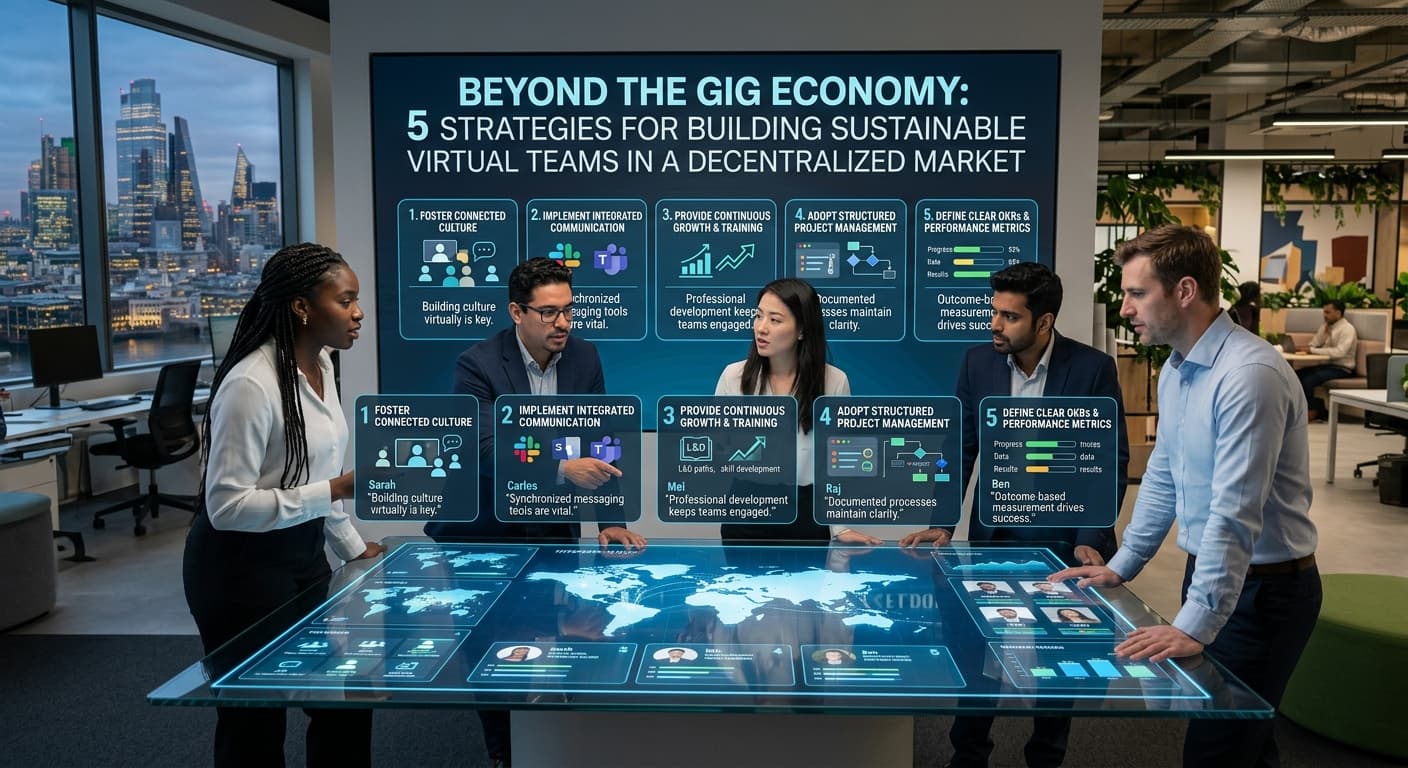
5 Strategies to Shift from Gig to Sustainable Virtual Teams
If you're ready to build a virtual team that isn't just a collection of freelancers but a cohesive, high-performing unit that contributes directly to your long-term vision, here are five strategies to guide your transition.
1. Cultivate a Culture of Belonging, Not Just Task Completion
The greatest weakness of the gig economy is the lack of connection. A freelancer who is jumping from one client to the next has little incentive to invest emotionally in your company's mission. To build a sustainable virtual team, you must consciously create a culture of belonging. This means your communication shouldn't just be about project updates and deliverables. It should be about shared values, celebrating wins, and fostering genuine relationships. Make an effort to understand what motivates your team members, not just what they're producing. Regularly share your company’s vision and show them exactly how their work contributes to that big picture. When people feel like they belong, they are more engaged, more loyal, and more likely to go above and beyond.
2. Invest in Long-Term Professional Development
One of the biggest differences between a gig worker and a full-time employee is the expectation of growth. Gig workers are hired for the skills they *already have*. In a sustainable virtual team, you should hire for potential as well as proficiency and then invest in unlocking that potential. This isn't just good for your team members; it's essential for your business. The market is evolving at an incredible pace, and the skills that are valuable today may be obsolete tomorrow. Provide opportunities for learning and development—whether it’s formal training, mentorship, or even just cross-functional projects. This shows your team members that you are invested in their future, which, in turn, makes them want to invest theirs in your company.
3. Move from Output-Only to Performance Management
In the gig economy, you often measure success by a single metric: *Did the work get done on time and to the spec?* That's a transactional view of productivity. While timely delivery is, of course, important, a truly sustainable virtual team requires a more robust approach to performance management. This means setting clear, realistic, and mutually agreed-upon goals (think OKRs or KPIs) that go beyond simple task completion. Focus on impact and outcomes, not just activities. Provide regular, constructive, and ongoing feedback, not just a binary “pass/fail” at the end of a project. When you manage performance, you create a framework for continuous improvement and shared accountability, which is essential for any high-functioning team.
4. Re-imagine Compensation and Benefits for a Remote Workforce
This is a big one. To build a sustainable virtual team, you cannot treat compensation as a one-size-fits-all model based on gig-economy rates. You need to create a package that is fair, competitive, and tailored to a remote reality. This could mean offering a combination of salary and performance-based bonuses, providing a wellness or technology stipend, and, most importantly, creating a pathway to stability (like longer-term contracts). It's also critical to think creatively about benefits. Can you offer flexible hours, paid time off, or perhaps even a learning fund? Your compensation structure should not only attract great talent but also make them *want to stay*. When you offer stability and a sense of partnership, you move from the transactional to the transformational.
5. Create Opportunities for (Virtual) In-Person Connection
The final and perhaps most counterintuitive strategy for building a virtual team is to prioritize non-virtual interaction. We may be living in a digital world, but we are still fundamentally social creatures who crave in-person connection and shared experiences. While your day-to-day operations should be seamless and efficient in a virtual environment, you need to deliberately plan for opportunities for your team to connect on a human level. This could be a quarterly in-person retreat, an annual company all-hands, or even just smaller, regional meetups. This isn't just a "nice-to-have." These in-person connections build trust, empathy, and a level of rapport that is virtually impossible to duplicate solely through a screen. It’s the grease that makes the gears of your decentralized machine turn smoothly.
The Future of Work is Distributed, But It Must Be Rooted in Commitment
Building a sustainable virtual team in a decentralized market is not a project; it's a practice. It requires a fundamental shift in how you view talent, leadership, and even the very concept of a "company." It's an ongoing journey from the purely transactional gig model to a relational one built on a foundation of trust, investment, and shared purpose. While the path may seem more challenging than simply tapping into a freelancer marketplace, the reward is a loyal, high-performing, and resilient team that is uniquely equipped to navigate the complexities of our new economic reality and drive your business forward for the long haul. The gig economy gave us a model for access. Now, it's our job to build a model for stability and sustained success.